


Leg training with the squat

Leg training with the Squat – Raise your hand if you have never presented yourself with a disturbing sense of anxiety at the most feared appointment of the week. Those who have been practicing body building for some time and with a minimum of seriousness and determination have already understood what I’m talking about: I’m talking about leg training. Yes, because if in the other training sessions we have sung victory over biceps and pectorals, triceps and so on looking at ourselves in the mirror once, ten, a hundred times with satisfaction, now it’s up to the legs, and you don’t mess around with your legs anymore: that day is arrived on time. Often and gladly athletes can be observed who have effectively developed the muscles of the upper body but who have insufficient hypertrophy in the lower limbs, assuming an overall unenviable shape that I jokingly call “ice cream cone”. I am sure this is not what we want. What we want is to sculpt strong and voluminous legs at 360 degrees including calves, let’s face it without hypocrisy. Without knowing it, we took a first important step: establishing a target, an objective to be achieved. I really love working towards goals. Whether we like it or not, the legs are made up of such massive muscle bundles that they always require very high loads to get to “volumize” in a satisfactory way.
Leg training with the squat
So let’s forget about our “tiring” series of ten to the horizontal press or the curl for the hamstrings with 30 kilos of weight. To properly hypertrophy the muscles of the lower limbs requires loading, loading and more loading. Up to the limit of endurance but always well away from the injury threshold. After all, training your legs is almost a metaphor for life: knowing yourself and your limits as much as possible and waiting patiently for the results of our efforts. On a psychological level I see that patience is very often a plant that few like to cultivate; everyone would like a magazine body quickly and easily. I too admit that I have been affected by the virus of impatience several times, in the course of months and years of training, but it must be remembered that in the practice of body building there is nothing easy and immediate, and this is because the body considers a luxury the increase in muscle mass which later will have to nourish and oxygenate. It is no coincidence that a Ferrari pays much more taxes than a small car, so if it’s a Ferrari we want, let’s get ready to work hard. Personally, I don’t like to try my hand at a large number of different exercises in the gym; my watchword has always been “simplify”, favoring large multi-joint exercises to the detriment of the use of machines or isolation exercises. Perhaps this is a legacy from when I was training fifteen years ago, in a time when there was only crude “body building” and there was still no talk of “fitness” and other refinements. However, I have nothing against the use of guided load machines, which we can always return to or resort to at the end of the months of hard routines based on old-fashioned exercises, the main one of which is certainly the free squat.
Leg training with the squat
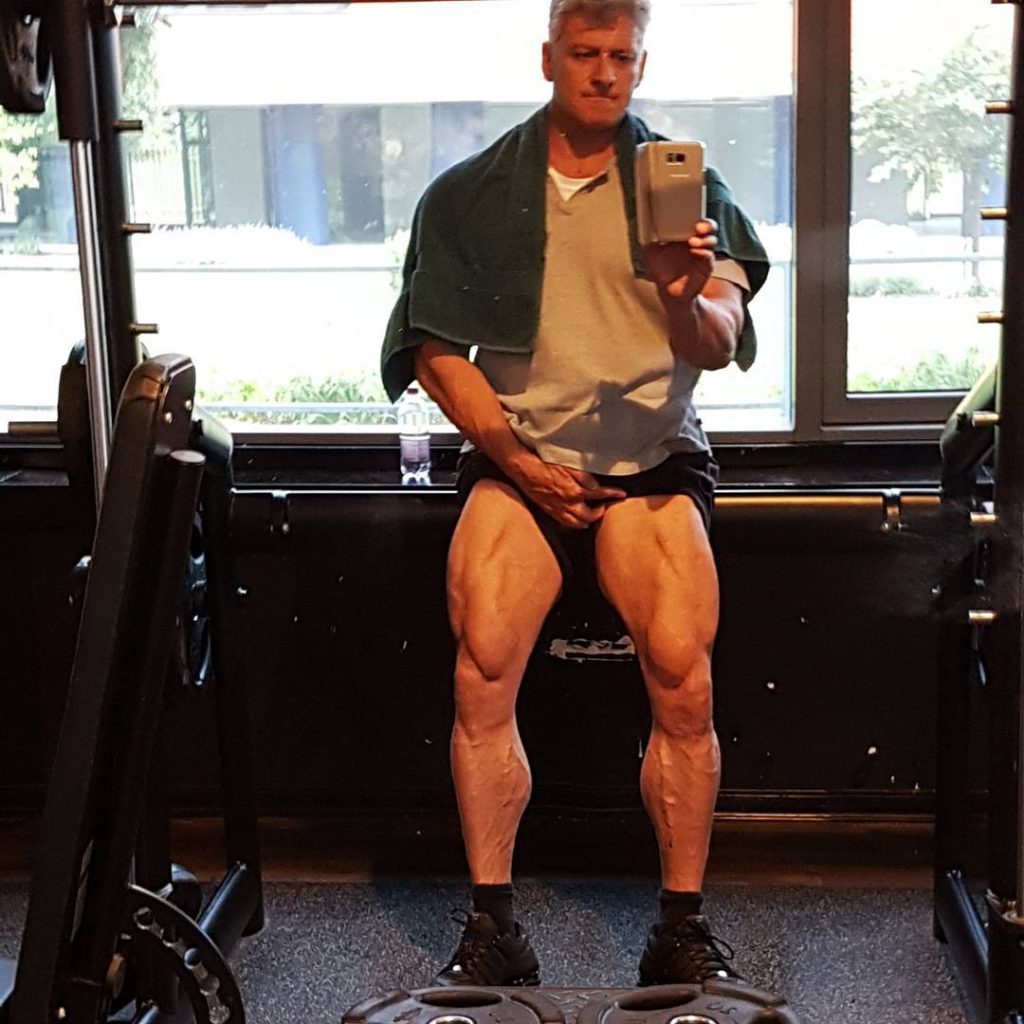
Leg training with the squat
I consider the free squat the king of all multi-joint exercises, almost a kind of divinity that bestows rewards or punishments depending on how you approach it. This is why mine is not a simple weekly squat session but an almost sacred liturgy to which I do not hide that I go every time with a certain fear. With the squat there are no half terms; that sensation you get when you detach the balance wheel from the supports is unrepeatable: we feel like we have a cubic meter of concrete weighing on the trapezes. Well, that’s where we need to move on. The impalpable threshold, the stargate, is there: those who get scared and go back will get the results they deserve: mediocre. Whoever has courage and continues will be rewarded by the god-squat. So let’s see how to structure a leg training session that is truly productive and not distracting:
Leg training with the squat
- We start the squat only after at least six months of strengthening the legs with other less complex and more specialized exercises such as Leg Extension, oblique press, lunges, etc. Be careful because paradoxically, it is precisely the exercises that seem harmless that can hold nasty surprises. In particular, we keep the lower part of the back glued to the back of the oblique press: we will avoid playing with the lower part of the spine. Let’s not be fooled by the guided trajectory of the gym machines and the sense of safety they seem to convey.
Leg training with the squat
- We work a lot on the lumbar muscles, without necessarily weighing ourselves down with ten-kilo discs held in the chest: four sets of the type 20-20-15-15 are enough but performed consistently at least once or twice a week. Consistency is what matters. We do not hyperextend the torso, we do not take advantage of the rebounds, we do not rush this useful exercise out of concern and desire to finish. The lumbar muscles may not be beautiful to look at, but they are and remain indispensable muscles. Let’s not neglect the abdominals either. Our ultimate goal is to erect a support belt that makes the back a sturdy “trunk” capable of withstanding the weight of the barbell. The lumbar work should never be placed in the drawer but continued even at the end of the preparatory months.
Leg training with the squat
- I have often read wonders about another great multi-joint exercise: the deadlift. I have tried it for months and I have found that no matter how hard you can commit to correct execution, the mechanics are so unfavorable that sooner or later your back will be compromised at all levels. In my opinion the game is not worth the effort, also because the deadlift really requires a lot of weight to become productive, and at that point it became too dangerous. In the absence of a trap bar, or square barbell, which should allow you to do the deadlift safely but which we will probably never have, we therefore leave this exercise to the powerlift practitioners who, goodness them, perform it in full version. I start the squat session after doing four sets of ten of the leg extension with light weight to pre-congest the quadriceps. In the breaks between one series and the next, I force myself not to chat but do stretching exercises for the hamstrings, quadriceps and calves. The calves have already worked first on the seated calf (4 sets of 10-12 reps) and the standing calf (2 sets of 30-50 reps). In the calf I look for the maximum possible articular excursion, even when it seems to slide off a cliff and the calves burn with pain. For all muscles, but more than ever for the calves, the concept of genetic predisposition applies: in short, if we have few basic ones it will be much harder to see them grow. So let’s not expect immediate progress for the calves; perhaps the best attitude is not to expect too much from this very difficult muscle district to develop. Any result will then be welcome. So here we are at the free squat: I perform a first series of 15-20 repetitions for warming up and to become familiar with the mechanics of the exercise. I use 60% of the expected load in the last series.
Leg training with the squat

Leg training with the squat
I do not require assistance and I wear the lumbar belt, not so tight as to prevent breathing but not so wide as to be useful only for “show”. I perform this first series in complete squat taking advantage of the still reduced load. That is, I go down as low as possible with the buttocks to stimulate this area as well, which has a useful support function and which, in any case, the preparatory work done in the months prior to the oblique press should already have developed. In the second series I use 80% of the expected load for the last series: I kindly ask for reliable assistance, if possible. Those who assist should not stay behind, crossing their arms and looking elsewhere, but must touch the waist following the movement, making us feel that “there is” and that we can trust by focusing only on the thrust. Jokes are not allowed during the year; it might seem nonsense, but when you work with a ton on your back it is better not to laugh, on pain of deconcentration and injury: when we have put away the load we can laugh as much as we want, if we have the heart. Breathing must be flawless: inhale while standing and hold when you go down, keeping your back as rigid as a piece of marble. We focus on the pushing movement, which I perform in this series keeping the legs very close together, almost together, to stimulate the growth of the vastus lateralis, the outermost sector of the quadriceps. I do repetitions until I am unable to do so and allow myself two minutes of recovery. End of the second series. The third and fourth series are those of real load: I use respectively 87% and 100% of the load that I am able to withstand in that particular period. Excessive loads are heralded by disturbing signals usually in the upper back sectors; these are alarm bells that must be listened to carefully. Only by showing humility and obedience will the squat-god dispense gifts: the weight must always be calibrated well with additions of a few kilos at a time in progress; additions of ten kilos are poorly tolerated; additions of twenty kilos per side, as I have seen done, are impossible. Let us never forget the virtue of patience and put aside exhibitionism.
Leg training with the squat

The last two series therefore: obviously require reliable assistance and all the determination that we are able to bring out. All means all. I have no set repetitions, I conduct the exercise up to the point of inability: after all, removing a barbell weighing more than a ton from the supports is not a joke, so we might as well go all the way as long as you can. I keep my legs shoulder-width apart and my feet slightly apart. I do not perform the complete squat because the load would not allow it; we do not listen to incitements and sirens in that direction: we are under the balance and we must get out unscathed. After the last repetition, I wait to release the tension until the bar is safe on the rack; some accidents can occur precisely in this phase, in which the load is maximum but one begins to relax. We place the barbell gently to avoid abruptly relieving the spine and take stock of what we have brought home: we performed an important multi-joint exercise diversifying the movement into three parts: full squat, legs together and finally two phases of load with legs spread apart for hypertrophy. Except the first, we have conducted all the series to exhaustion. One last tip: if I squat in front of a mirror, I prefer to darken it; this is because during the execution we should always look up and never in front of us: looking ahead distracts and leads to lowering the gaze, the head and finally the back in succession with all the conceivable consequences. The leg training continues with five series at the Leg Curl also conducted to exhaustion, the first four with increasing load as before, the fifth at 80% of the maximum load. The sense of victory given by the previous squat session should instill courage and allow you to fully train this muscle district, which will help to round the back of the legs, often neglected because it is not very visible. The hamstring curl also requires high loads, so let’s get into it but not enough to play with the hamstrings. Stretching between one series and another is not an option but a duty. And when we are lying down in the curl we look forward without turning our heads: you risk a stiff neck easily. The hardest and most feared day ends with the four series on the bench press for the lumbar muscles of which we said: 20-20-15-15 without necessarily weighing us down and without haste. If we have a parallel-bar combination available, we can hang on the bar by extending our feet downwards, to decompress the vertebrae on which we have placed the barbell on. I recommend doing this routine for no more than four to six months, locating it in the autumn-winter period. We can then switch to guided load machines to rest our back and avoid future discomfort as much as possible. Our “old-fashioned” session ends here, but a serious workout should continue at home, and especially at the table, by taking protein from white meats in adequate quantities to nourish and reward our body. In the next two days we will find ourselves with toned, rounded and aching legs, and we will promise ourselves that next time we will do more, if the diosquat allows it. While we wait, let’s try to have a little pity for that mirror by now tired of seeing us posing, and let’s relax: we still have some time before another quiet workout of fear! Good workout.
Leg training with the squat